

Everyone ignored body care. Then Salt & Stone made it the fastest-growing category in prestige beauty.
$165 million in revenue. Profitable since day one. The number-one selling deodorant at Sephora, Amazon, and Erewhon – simultaneously. A Kendall Jenner collab launching the same week as a private equity acquisition. Fifteen PE firms in talks. And only one got the deal.
Last week, Advent International – the firm behind Olaplex and Parfums de Marly – signed a deal to acquire a majority stake. They weren’t alone. Fifteen private equity firms were reportedly in the running. Advent won. Terms undisclosed, but the signal is clear: Salt & Stone just graduated from indie darling to institutional bet.
This is the story of how a former professional snowboarder built a beauty empire out of the one product nobody else wanted to make prestigious. And why the playbook matters more than the product.
the most slept-on category in beauty built itself a luxury brand
Nima Jalali didn’t come from beauty. He came from snowboarding.
A knee injury in his twenties sent him down the path most wellness founders describe in hindsight – natural foods, cleaner products, a growing awareness that everything he was putting on his body was, in his view, garbage. He went looking for a deodorant and a sunscreen that actually worked, smelled good, and didn’t look like it belonged in a hospital gift shop.
He couldn’t find one. So in 2017, he made his own.
Salt & Stone launched from a studio apartment in Los Angeles, starting with sunscreen, before expanding into deodorants shortly after. No beauty industry connections. No pitch deck to Sephora. The name came from the two landscapes that shaped him: salt from the Pacific Ocean where he surfed, stone from the mountains where he rode.
What happened next defied every convention the beauty industry holds dear.
Within weeks of launching, Colette – a Parisian concept store – reached out to stock the brand. Not because Jalali had a publicist. Because the product looked like nothing else in the category. A weeks-old brand, founded by a snowboarder, operating out of an apartment, landed in one of the most curated retail spaces on earth at the time.
That moment told Jalali something the rest of the industry would take years to understand: body care wasn’t boring. It was just badly designed.
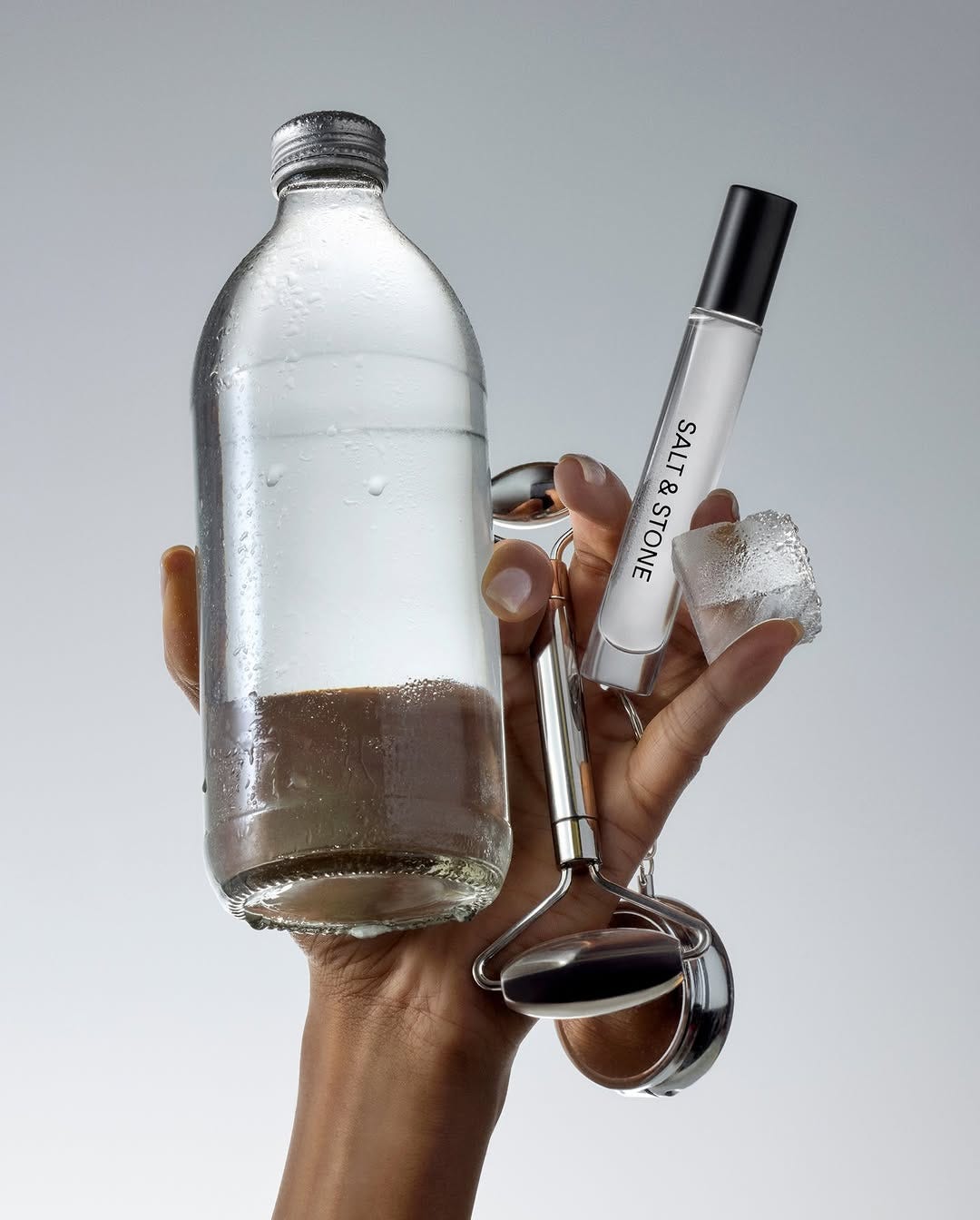
a deodorant that outsells everything else on the shelf
Here’s what Salt & Stone figured out before anyone else.
The prestige beauty consumer – the person who’ll spend $78 on a Glossier fragrance or $75 on a Le Labo candle – was still buying deodorant at CVS. Not because they wanted to. Because no one had given them a reason not to. The gap wasn’t only in formulation. It was in aspiration.
Salt & Stone’s hero product is a $20 aluminium-free deodorant. That’s it. A stick of deodorant. It accounts for 40% of the brand’s total revenue and currently sells one unit every five seconds.
But the $20 price point is doing something much more interesting than generating margin. It’s sitting in a white space between the $5 mass-market stick and the $40 niche indie. Affordable enough to trial. Premium enough to signal taste. And – critically – fragrant enough to replace a layer of your scent wardrobe.
This is where Salt & Stone quietly rewrote the category. Jalali didn’t just reformulate deodorant. He hired DSM-Firmenich – the same fragrance house behind some of the most iconic scents in luxury perfumery – to develop the core scent collection. Santal & Vetiver. Bergamot & Hinoki. Black Rose & Oud. Neroli & Basil. Saffron & Cedar. These aren’t deodorant scents. They’re fragrance compositions that happen to live in a deodorant format.
The result is a product TikTok now openly compares to Le Labo’s Santal 33 – a $340 fragrance. Salt & Stone’s version costs $20 and goes under your arms. The internet did the marketing for free.
If your $20 deodorant is being compared to a $340 fragrance, you’ve won a positioning war most brands don’t even know is being fought.
the channel strategy nobody talks about
Salt & Stone is the number-one deodorant at Amazon. It’s the number-one deodorant at Sephora. It’s the number-one deodorant at Erewhon.
Read that again.
The same brand dominates the prestige channel and the mass marketplace. That almost never happens. Prestige brands avoid Amazon because it dilutes their positioning. Amazon brands can’t break into Sephora because the consumer perceives them differently. Salt & Stone did both – and did them simultaneously – without cannibalising either.
How?
Jalali’s approach was counterintuitive from the start. Instead of chasing retail, he built digital first. Every dollar went into the website, the ads, the email flows, the customer experience. The strategy was simple and ruthless: become a brand so compelling that Sephora has to come to you.
They did. Sephora reached out – Jalali never pitched them. The brand launched into roughly 100 Canadian doors and 290 US doors in early 2024. By the end of that year, it was Sephora’s top deodorant partner. In the UK, where Salt & Stone launched at Sephora in late 2023, it became the retailer’s number-one deodorant and second-biggest body brand.
Meanwhile, Amazon served a completely different function. It wasn’t about prestige. It was about discovery and conversion for a consumer who searches “best natural deodorant” at 11pm and wants it delivered tomorrow. Salt & Stone showed up in that search with a product that looked nothing like anything else on the page – minimalist sans-serif type, muted earth tones, the kind of packaging you’d actually leave on your bathroom counter.
And then there’s DTC, which still accounts for 40% of sales even after the Sephora expansion. The brand didn’t abandon direct-to-consumer as it scaled wholesale. It maintained it as a community channel – the place where the most loyal customers buy, where new scents drop first, where collaborations launch before they hit retail.
Three channels. Three different consumer behaviours. One brand identity that never bends. That’s the architecture.

the collaboration flywheel
Salt & Stone doesn’t collaborate like a beauty brand. It collaborates like a streetwear label.
Stüssy. Brain Dead. Outdoor Voices. Leon Bridges. An Erewhon smoothie. Solidcore as an amenity partner. And now – in the same week as the Advent acquisition – a limited-edition Amber & Agave collection with Kendall Jenner’s 818 Tequila, timed to Coachella.
The pattern is deliberate. Each collaboration pulls Salt & Stone into an adjacent cultural space – music, fashion, fitness, food, spirits – without ever diluting what the brand actually is. The collaborations don’t say “we’re for everyone.” They say “we exist in the same world as these things you already care about.”
Jalali is explicit about this. He doesn’t frame collaborations as business strategy. He frames them as creative expression. But the business outcome is obvious: each partnership introduces Salt & Stone to an audience that would never have found it through beauty marketing alone. A Stüssy customer discovers Salt & Stone. A Solidcore member discovers Salt & Stone. A Kendall Jenner fan discovers Salt & Stone. And the product – a $20 deodorant that actually smells like something worth wearing – converts them.
This is the anti-Glossier playbook. Glossier expanded its product portfolio to reach new consumers. Salt & Stone expanded its cultural footprint while keeping the product portfolio tight. Same goal. Opposite execution. Radically different outcome.
the economics behind a boring product
Body care doesn’t get the attention that fragrance or skincare gets in the beauty industry. It’s not as glamorous. The ticket prices are lower. The repeat purchase cycle is faster but less emotionally charged.
But the numbers tell a different story.
Prestige deodorant sales grew 24% in 2024 while mass deodorant grew just 1%. Premium body care outpaced the wider skincare market with 20% value growth across Europe in the same period. Sol de Janeiro – the closest comparison in terms of category creation – surpassed $2 billion in global sales, built primarily on body care and fragrance mists.
Salt & Stone has been profitable since launch. Not profitable-after-a-Series-B. Profitable from the first product shipped. According to industry sources, revenue quadrupled in both 2022 and 2023. The brand was projected to hit $65 to $80 million in 2024 and surpassed $165 million in 2025 with double-digit growth across every channel.
The margin structure is quietly compelling. Deodorant is not a high-COGS product. Add premium fragrance positioning and a $20 price point that’s four times the mass-market average, and you have a business that generates real cash flow. When Jalali says the brand has been profitable since day one, the category economics explain why.
Humble Growth made a minority investment in August 2024. Eighteen months later, they’re exiting into the Advent deal. That is an extraordinarily fast return cycle in beauty investing.

what Advent is actually buying
Advent International doesn’t acquire brands that are peaking. It acquires brands it believes are at the beginning of their second act. Olaplex was pre-IPO. Parfums de Marly was pre-scale. In both cases, Advent provided the operational infrastructure and global distribution muscle to turn a cult brand into a category leader.
Salt & Stone fits the same thesis. The brand has $165 million in revenue, but it’s still nascent compared to the incumbents. Dove. Axe. Nivea. The personal care category is a $29 billion market, and Salt & Stone barely registers as a rounding error in global share.
But that’s the point.
The premiumisation wave that remade skincare in the 2010s and fragrance in the 2020s is now arriving in body care. Consumers who traded up from Olay to Drunk Elephant are now trading up from Dove to Salt & Stone. The question is not whether premium body care is a real category – Sol de Janeiro settled that – but who will own it.
Advent is betting the answer starts with a deodorant that smells like Santal 33.
The brand is already in 1,700 doors across 40 countries. But much of that is concentrated in North America and the UK. Sephora Europe is a recent addition. Space NK is new. Asia is untouched. The growth runway for international expansion is, by beauty standards, enormous.
And then there’s category expansion. Salt & Stone started in sunscreen, pivoted to deodorant, expanded into body wash, body lotion, body mist, hand cream, and candles – all anchored to the same five core scent families. A fragrance line is the obvious next step. Body oils launched in 2026. And a first standalone store is in the works.
Advent’s director David Paresky said it directly: they believe Salt & Stone can premiumise personal care the way Olaplex premiumised hair care. That’s not a small claim. Olaplex went public at a roughly $14 billion valuation and is now being acquired by Henkel for a fraction of that. Its post-IPO trajectory has been rocky, and Advent’s acquisition of bareMinerals, Buxom, and Laura Mercier from Shiseido produced mixed results.
But the underlying logic is sound. If you can own the moment a consumer decides their deodorant should smell as good as their perfume, you own a transition that the entire category is about to go through.
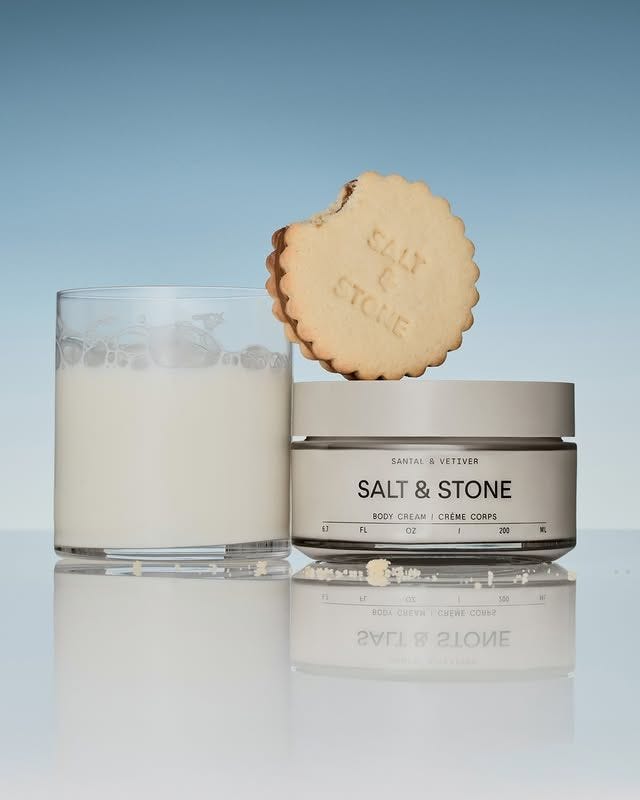
what the industry should be learning
Salt & Stone didn’t invent clean beauty. It didn’t invent premium body care. It didn’t even invent the idea that a deodorant could smell like a luxury fragrance.
What it did was something harder: Salt & Stone executed against a clear thesis with total discipline for eight years, and it never once deviated.
The thesis was always the same. Body care is a design problem, not a formulation problem. If you make it look right, smell right, and feel right, the consumer who spends $340 on Le Labo will spend $20 on your deodorant – and then $36 on your body wash, and then $45 on your body mist, and then they’ll buy all three for their partner too.
Jalali didn’t chase launches. Salt & Stone has five core scent families. Not fourteen. Not forty. Five. Everything in the product line ladders up to those five scent profiles, which means every product reinforces every other product, and the consumer builds a routine rather than making isolated purchases. That’s how you get a DTC channel that still accounts for 40% of revenue at $165 million in sales.
He didn’t chase press. He built a brand that looked like it belonged in the world of Stüssy and Le Labo and Erewhon, and then he let those worlds come to him. Sephora came to him. Colette came to him. Advent International came to him. The lesson is not “don’t pitch.” The lesson is: build something so good that pitching becomes unnecessary.
And he didn’t chase funding. Salt & Stone was profitable from day one. While Jalali took undisclosed funding from strategic partners along the way, Humble Growth’s minority investment in 2024 was the brand’s first institutional capital raise – seven years in – and only after the model was already proven at scale. By the time Advent arrived, there was nothing to prove and everything to build.
The beauty industry is obsessed with the idea that growth requires complexity. More SKUs. More categories. More stores. More capital. More speed.
Salt & Stone is proof that growth can come from the opposite: fewer scents, fewer channels done better, fewer distractions. A $20 deodorant, executed with the care and precision of a fine fragrance, sold in the three places your consumer already shops, and extended only when the brand equity could support it.
The most boring product in your bathroom just attracted one of the largest private equity firms in the world.
That’s not a deodorant story. That’s a discipline story.
TL;DR
Salt & Stone didn’t invent premium body care. It proved that discipline and design can premiumise anything – even the category the beauty industry forgot existed.
A brand with five scent families, total channel control, and the patience to let retailers come to it will outperform a brand with forty products and a presence in every channel it can find.
$165 million in revenue. Profitable since day one. Number one at Sephora, Amazon, and Erewhon. Global distribution. A PE acquisition.
All from a studio apartment and a $20 stick of deodorant.
This was a honestly a great read 💌 quite insightful
This is impressive and a great read!
The beauty industry is such an exciting place to be.
The brand story is so interesting … and so authentic. They’ve made some really smart moves (whether planned or not!). The clear category focus and aligned messaging, strong brand identity, approach to partnerships & collaboration and performance marketing strategy to compliment/strengthen the brand is actually relatively ‘simple’ but what so many brands fail to identify and execute.
I hope the continue to build the brand successfully (and have fun ✌🏼) x